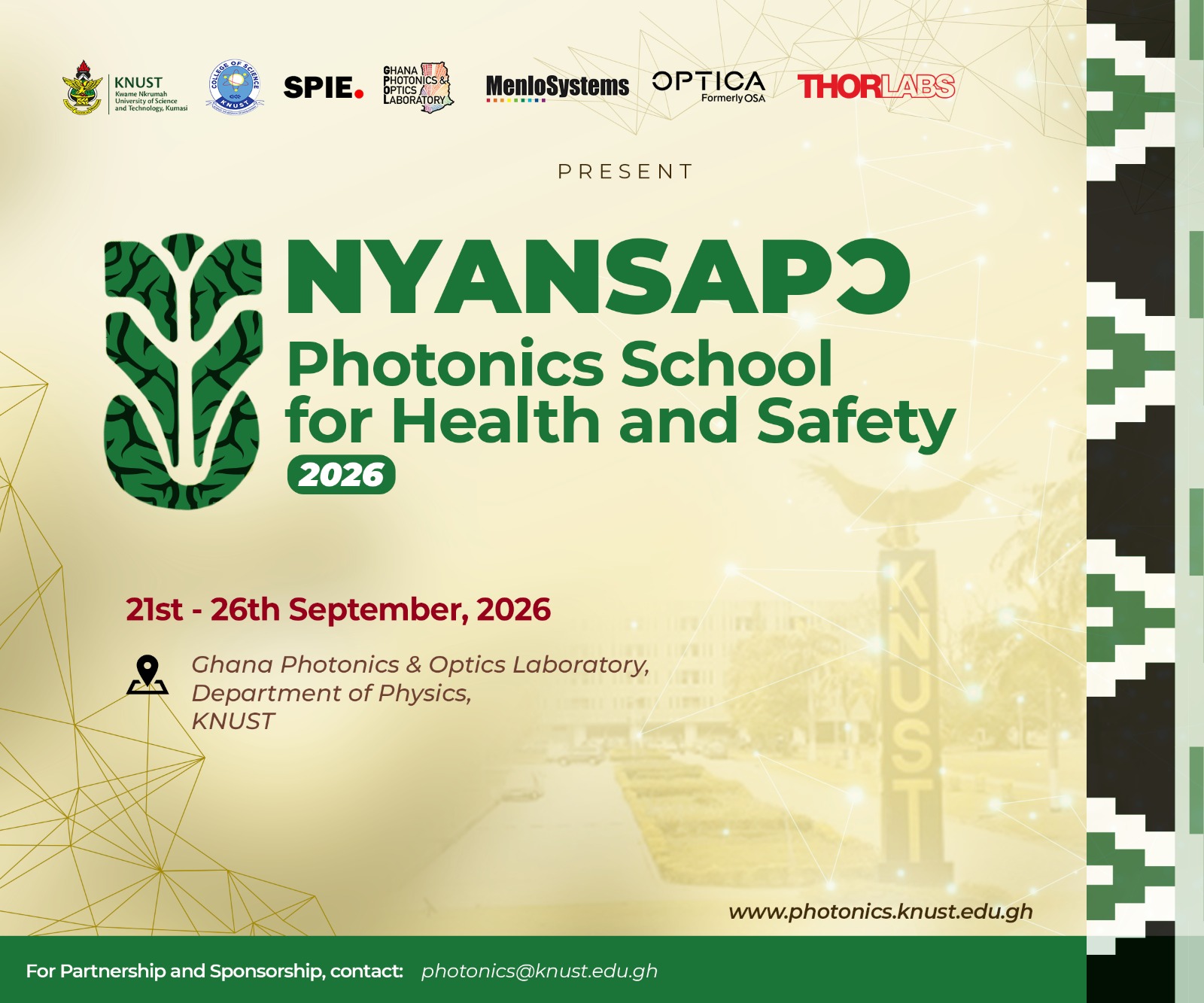
NYANSAPƆ Photonics School for Health and Safety 2026
21 – 26 September 2026 | Department of Physics, KNUST, Kumasi, Ghana
The NYANSAPƆ Photonics School for Health and Safety is a six-day, hands-on training school hosted by the Ghana Photonics and Optics Laboratory (GPOL) at the Kwame Nkrumah University of Science and Technology (KNUST).
This school is made possible by SPIE, our Title Sponsor, and co-sponsors Optica, Menlo Systems, and ICFO.
The school will equip participants with practical skills in modern photonics, applied to the real health, safety, and measurement challenges facing West Africa.
What you will learn
Guided, hands-on sessions across the core techniques of applied photonics, microscopy, and spectroscopy:
- Multispectral Spectroscopy: spectral imaging for food, pharmaceutical, and environmental analysis
- Fluorescence Spectroscopy: fluorescence-based sensing and measurement for biological and chemical samples
- Raman Spectroscopy (including Through-Package Raman): molecular fingerprinting for material identification, quality control, and non-invasive analysis through packaging
- Laser-Induced Breakdown Spectroscopy (LIBS): rapid elemental analysis of solids, liquids, and gases
- Low-Cost OCT (Optical Coherence Tomography): affordable depth-resolved imaging for medical diagnostics
- Diffuse Optics: non-invasive tissue monitoring using near-infrared light
- NMRduino: low-cost nuclear magnetic resonance instrumentation
- Optical Tweezers: laser-based tools for trapping and manipulating microscopic particles
Who should apply
The school is open to BSc final-year, MSc/MPhil, and PhD students in Physics and closely related fields. Applicants from Ghana and across West Africa are especially encouraged. Selection considers academic performance, motivation, institutional diversity, and gender equity.
Why attend
Leave with practical laboratory skills, hands-on experience with open-source photonics platforms, and connections to an international network of researchers.
Code of Conduct
All participants, faculty, and volunteers are expected to read and follow our Code of Conduct.
Places are limited to 30 participants. Apply now to join the inaugural cohort.
The organisers gratefully acknowledge SPIE as Title Sponsor, our co-sponsors Optica, Menlo Systems, and ICFO, and the College of Science, KNUST, as host.
📧 photonics@knust.edu.gh | 🌐 photonics.knust.edu.gh